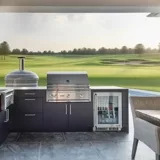
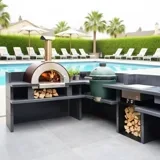
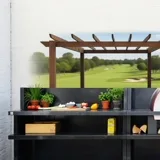
The published specification is LED lighting in four layers - task, ambient and dining, accent, and safety - on smart dimmers with motion sensors. Task lighting is published at 3,000-4,000K for food-preparation color accuracy, ambient and dining lighting at 2,700K warm white with commercial-grade string lights rather than residential, accent as under-counter LED strips and uplights, and safety as 12-volt low-voltage path lights with stair riser lights, which are code required for steps with 3+ risers. Fixtures are specified as IP65+ rated and weatherproof. A low-voltage lighting package is published at 500 - 1,500 installed, and the site-wide project band is 15,000 and 35,000. Tampa Outdoor Kitchens is a free matching service, not a provider.
What it costs in Clearwater
| Job | Published 2026 range |
|---|---|
| Built-in gas grill, installed | 1,500 - 5,000 |
| Pizza oven, installed | 1,000 - 8,000 |
| Outdoor-rated refrigerator | 800 - 3,500 |
| Sink with plumbing | 300 - 2,000 |
| Gas line run from the meter | 400 - 2,000 |
| Low-voltage lighting package | 500 - 1,500 |
| Running gas, water and electric lines together | 2,000 - 5,000 |
| Underground line runs and trenching | 500 - 2,000 |
| Permit allowance | $75 - $400 |
| Removal or demolition, per unit | 25 - 60 |
The four layers, and what each one is for
Lighting over a cooking surface is a task spec, not a mood board. The published layers are ranked by job, and each one carries its own color temperature.
| Layer | Published specification | What it is for |
|---|---|---|
| Task | LED strip lights under the pergola beams over the grill and prep areas, 3,000-4,000K | Food-preparation color accuracy, bright enough to read meat thermometers after sunset |
| Ambient and dining | Dimmable pendants over the dining table, 2,700K warm white; commercial-grade string lights over the seating area | Eating, talking and entertaining without glare |
| Accent | Under-counter LED strips on the bar and kitchen base; uplights on trees and landscape features | Depth, separation and architecture after dark |
| Safety | Path lights along walkways and steps, 12-volt low voltage; stair riser lights | Footing and visibility on the route in and out |
Two published details decide whether the task layer works at all: 3,000-4,000K is specified for food-preparation color accuracy rather than the warmer domestic tone, and the strip has to be bright enough to read a meat thermometer after sunset. A warm decorative strip over a grill is a good-looking failure.
Why one layer alone fails
The published lighting guidance states it plainly: any one layer alone fails. Task lighting without ambient produces a glare-lit workbench and ambient lighting without task is atmospheric but unsafe over a hot grill. That is not a style opinion, it is the reason a lighting plan is quoted as a system rather than as a fixture count.
In practice the failure looks like this: a single bright source over the grill casts a shadow into the prep area and blinds everyone facing it; strip light alone leaves the dining table in the dark and the walkway unlit; decorative string lights alone are the arrangement that makes a hot grill unsafe at night.
| What is installed | What is missing | Result |
|---|---|---|
| Task only | Ambient | A glare-lit workbench |
| Ambient only | Task | Atmospheric but unsafe over a hot grill |
| Accent only | Task and safety | Beautiful walls, dark counters, unlit steps |
| All four layers | Nothing | Each layer covers the others' weakness |
String lights are published with their own qualifier: commercial-grade, not residential. Residential strings are not built for permanent outdoor installation, and the published list of what to look for on anything that lives outside is marine-grade or weather-rated construction, sealed electrical connections, and covers rated for UV exposure.
Control, dimming and the electrical plan behind it
All lighting is published on smart dimmers with phone or voice control, with scenes for Cooking, Dining and Party, and motion sensors for the safety lights. Scenes exist because a kitchen at midnight and a kitchen during a party are not lit the same way, and dimming is what makes a single installation cover both.
Control is only as good as the circuit plan. Published guidance is that the electrical plan puts the lighting, the fridge and any heater on dedicated circuits, with GFCI outlets code required and at least one at counter level. Strand lighting in the beam line, pendants over the table, under-counter strips and 12-volt path lights are four different loads, and they should not share one switch leg with a fridge.
Voltage and rating matter as much as the layout: path lights are specified at 12-volt low voltage, and fixtures are specified as IP65+ rated and weatherproof. A low-voltage lighting package is published at 500 - 1,500 installed, which is a small line item against the published 2,000 to 5,000 for running gas, water and electric lines to the zone, and the published 500 to 2,000 for the underground line runs and trenching that many quotes leave out.
Local note for Clearwater
NRCS Soil Data Access point queries across Clearwater return Urban land, 'Myakka soils and Urban land' on the inland side and 'Matlacha and St. Augustine soils and Urban land' toward the coast; the natural profile underneath is poorly drained sandy flatwoods soil (Myakka series, a Spodosol with a spodic Bh horizon and a seasonal water table near the surface), not anything bearing-grade (https://soilseries.sc.egov.usda.gov/OSD_Docs/M/MYAKKA.html). An island footing in Clearwater therefore bears on sandy fill over that water table and wants over-excavation and compacted structural fill rather than a surface pad.
Clearwater's own Public Utilities department supplies the city from about 11 million gallons of potable water a day: roughly 60% is pumped from city-owned and city-operated wells in the Upper Floridan Aquifer, and the remaining daily demand is purchased from Pinellas County Utilities, which in turn buys from regional wholesaler Tampa Bay Water. The city's well water is filtered to remove suspended solids such as iron and then treated by reverse osmosis specifically to remove dissolved molecules including hardness-causing salts, disinfected with monochloramines and stabilised to protect the pipeline; the purchased Tampa Bay Water portion is a blend of Floridan groundwater, treated surface water from the Alafia and Hillsborough rivers and the C.W. Bill Young Regional Reservoir, and desalinated seawater from Hillsborough Bay. Source: City of Clearwater, The Quality of Your Water / 2026 Water Quality Report (https://www.myclearwater.com/My-Government/0-City-Departments/Public-Utilities/02-The-Quality-of-Your-Water).
Utility accounts: City of Clearwater Public Utilities Department · (727) 562-4960
Checking a quote in Clearwater
- Is the quote itemised for the island, the countertop, the appliances and the connections, or is it one lump sum?
- Who pulls the gas and electrical permits, and is that cost in the quote?
- Is the countertop templated after the island is built, and what happens if the measurement is wrong?
- Are the appliances supplied by the contractor or by me, and who handles their warranty?
- What is the workmanship warranty on the masonry and the countertop, separately from the appliance warranties?
Frequently asked questions
How much does outdoor kitchen lighting cost in Tampa?
A low-voltage lighting package is published at 500 - 1,500 installed. For context, the typical project range is 15,000 and 35,000, running gas, water and electric lines to the zone is published at 2,000 to 5,000, and underground line runs and trenching add 500 to 2,000 that many quotes leave out.
Why do I need more than one kind of light?
Because the published guidance is that any one layer alone fails: task lighting without ambient produces a glare-lit workbench, and ambient lighting without task is atmospheric but unsafe over a hot grill. The published layers are task (3,000-4,000K under the pergola beams over the grill and prep areas), ambient and dining (2,700K dimmable pendants and commercial-grade string lights), accent (under-counter strips and uplights), and safety (12-volt path lights and stair riser lights).
Are stair riser lights required?
Stair riser lights are published as code required for steps with 3+ risers, so any step run of three risers or more needs them. Path lights along walkways and steps are separately published at 12-volt low voltage, and fixtures are specified as IP65+ rated and weatherproof.