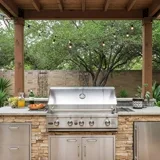
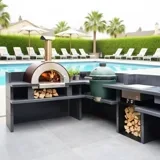
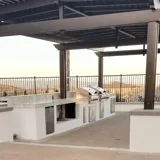
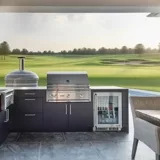
Outdoor kitchen construction in Tampa is a masonry and utility project that happens to end in a grill. The published numbers run across a wide band - 15,000 and 35,000 for a typical project, 8,000 and 15,000 for a basic built-in grill with modest countertops, and 20,000 and 50,000 for a full build with sink, fridge, pizza oven and stone counters - because the structure, the counter material and the utility runs are what you are actually buying. The published build is steel stud framing over a cement board substrate, finished in a stone or stucco exterior rated for 100+ degree heat, and a finished project is expected to give 15-25 years with proper maintenance, with many lasting even longer. Tampa Outdoor Kitchens is a free matching service, not a provider: we route your request to licensed local builders, we do not employ contractors, and we do not sell outdoor kitchens services.
What it costs in Wesley Chapel
| Job | Published 2026 range |
|---|---|
| Built-in gas grill, installed | 1,500 - 5,000 |
| Pizza oven, installed | 1,000 - 8,000 |
| Outdoor-rated refrigerator | 800 - 3,500 |
| Sink with plumbing | 300 - 2,000 |
| Gas line run from the meter | 400 - 2,000 |
| Low-voltage lighting package | 500 - 1,500 |
| Running gas, water and electric lines together | 2,000 - 5,000 |
| Underground line runs and trenching | 500 - 2,000 |
| Permit allowance | $75 - $400 |
| Removal or demolition, per unit | 25 - 60 |
What outdoor kitchen construction actually involves
A built-in outdoor kitchen is a structure before it is a cooking station. The published build description is specific: built-in gas grills, smokers, pizza ovens, refrigerators and bar seating, framed with steel studs that will not rot the way wood does in humidity, clad over a cement board substrate that gives stone or tile a water-resistant base, and finished with a stone or stucco exterior rated for 100+ degree heat.
The order of the layers is what decides how long the whole thing lasts. Working from the ground up, a concrete base carries the full dead and live load; a waterproof layer sits over it; the plumbing penetrations are the deliberate holes through both, and they are where water gets in; and the aggregate or stone finish is the visible top of the stack. The countertop and the appliance heads sit above that, on a substrate that has to stay dry for any of it to work.
| Layer | Published description | What it decides |
|---|---|---|
| Base | A 4-inch reinforced concrete slab on compacted gravel | Carries the full dead and live load |
| Frame and substrate | Steel stud framing, cement board substrate | Will not rot like wood in humidity; a water-resistant base for stone or tile |
| Exterior | Stone or stucco rated for 100+ degree heat | Finish life under sun and weather |
| Countertop | Granite, concrete or porcelain tile | Must be UV-resistant and handle thermal shock from hot pans |
| Equipment | Built-in gas grill, smoker, pizza oven, refrigerator, bar seating | Footprint, utility runs and ventilation clearances |
Pavers are the lighter alternative base for smaller builds, but they shift under heavy masonry and appliances, which is why the published guidance settles on a 4-inch reinforced concrete slab on compacted gravel for anything built of masonry or stone.
The published cost bands, per project and per linear foot
There is no single price for an outdoor kitchen, and the source material publishes several bands because they answer different questions. Read them as scopes rather than as estimates that can be averaged into one number.
| Scope | Published band |
|---|---|
| Basic kitchen with a built-in grill and modest countertops | 8,000 and 15,000 |
| Modest kitchen with grill, counter and storage | 10,000 to 20,000 |
| Typical project range | 15,000 and 35,000 |
| Full build with sink, fridge, pizza oven and stone counters | 20,000 and 50,000 |
| Custom build with pergola, refrigeration, cabinetry, sink and outdoor fireplace | 25,000 to 50,000 |
| Full kitchen-and-pergola package | 30,000 and 50,000 |
| Budget shape across the market | $5K for basic grill setups to $75K+ for full luxury kitchens with pergolas, pizza ovens and bars |
Per linear foot is the other way the same job is quoted, and the published counter-run rates carry their own lifespans and sealing intervals.
| Counter run | Published rate | Lifespan | Re-seal interval | Annual maintenance |
|---|---|---|---|---|
| Masonry block island with stucco finish | $250-450/lf | 25 yrs | 3 yrs | 150 |
| Stone veneer masonry with granite counter | $400-670/lf | 30 yrs | 4 yrs | 200 |
| Modular stainless cabinets with stone top | $350-700/lf | 20 yrs | 0 | 80 |
| Framed island with poured concrete counter | $200-350/lf | 15 yrs | 2 yrs | 250 |
| Kitchen under a pergola or patio cover | $450-900/lf | 25 yrs | 3 yrs | 220 |
What moves a project inside a band is published too: appliances, countertop material, and utility runs are the big-ticket items. Prices vary by 30 to 40 percent for the same layout based on appliance brands and stone selection, weather-rated grills and refrigerators carry a 30 to 50 percent premium over indoor models, and underground line runs and trenching add 500 to 2,000 that many quotes leave out.
Why the Tampa Bay area is hard on a permanent structure
A built outdoor kitchen is asked to hold its shape through Tampa Bay is humid-subtropical: the National Weather Service's Tampa Bay office covers a wet season running roughly June through September that supplies most of the year's rain, alongside summer heat indices that routinely pass 100F and year-round humidity that never really dries out. Layer an airborne-chloride film over everything within a few miles of the bay and the Gulf -- which is all seven of these towns -- and the specification is set by salt and moisture more than by heat. That drives three decisions: 316 (marine) stainless for every exposed metal surface including hinges, slides and fasteners, because the 2-3% molybdenum that grade 304 lacks is what resists chloride pitting in coastal air (the Australian Stainless Steel Development Association notes grade 316 is 'often chosen for more aggressive environments such as sea-front buildings and fittings on wharves and piers'); sealed marine-grade polymer boxes or a CMU/concrete core rather than standard 'outdoor' MDF or particleboard, which delaminates and swells in coastal humidity; and countertops that tolerate thermal shock and UV without an annual reseal. Rinsing metal with fresh water after salty spells and using breathable covers rather than non-breathing tarps extends the life of all three.. That is the reason the published exterior specification is a stone or stucco finish rated for 100+ degree heat over steel stud framing rather than timber: steel will not rot the way wood does in humidity, and the cement board under the finish gives stone or tile a water-resistant base.
Water is the other half of the problem. The published guidance is that the slab should slope away from the structure and include a floor drain if the kitchen has a sink or ice maker, because poor drainage leads to standing water, moss, and rusted appliance bases. Site conditions belong in the pre-build conversation, not the punch list: site drainage and USDA-NRCS mapping puts the Tampa area on Myakka fine sand -- Florida's official state soil and the single most extensive map unit in Hillsborough County (164,000 acres) -- a very deep, very poorly to poorly drained Spodosol (sandy, siliceous, hyperthermic Aeric Alaquods) formed in sandy marine deposits. Its diagnostic feature is a spodic 'hardpan' Bh horizon typically 20-36 in. down, above which permeability is rapid; the seasonal water table sits within 18 in. of the surface for 1-4 months in most years and recedes past 40 in. only in very dry seasons. For anchoring a kitchen island that is the whole problem: footing depth is set by the fluctuating water table and the spodic layer, not by frost, so over-excavate below the organic A/E horizons (roughly the top 20 in.) and found on compacted select fill or a thickened, reinforced slab edge rather than a shallow surface pad, or the pad will move as the water table rises and falls. Much of the built-up area is now mapped as Urban land or Myakka/Urban land complexes, so pull the site-specific map unit for the actual address in NRCS Web Soil Survey before footings are set. Sources: NRCS Official Series Description, Myakka series (https://soilseries.sc.egov.usda.gov/OSD_Docs/M/MYAKKA.html); NRCS Web Soil Survey (https://websoilsurvey.nrcs.usda.gov/app/). are two of the three things - weather patterns, soil characteristics, and building code requirements - that published guidance says to check before a design is finalized.
If the kitchen is going onto a wood deck, the published warning is direct. Wood decks are not designed for the weight and heat of masonry and built-in grills; they need a structural engineer review and heat shielding, or the deck may sag and pose a fire risk.
Living in the Tampa Bay area comes with its own set of common challenges, and every one of them has a proven, lasting solution when it is addressed by an experienced professional.
Local note for Wesley Chapel
NRCS Soil Data Access point queries around Wesley Chapel return a mix of moderately well drained Tavares sand on the knolls and ridges and wetter soils (Newnan, Pomona, Sparr, even Zephyr muck) in the flats; Tavares is a Quartzipsamment with less than 5% silt plus clay from 10 to 40 in. and a seasonal water table 42-72 in. down for most of the year (https://soilseries.sc.egov.usda.gov/OSD_Docs/T/TAVARES.html). On uniform sand with no shallow clay layer, an island footing holds best widened and set into compacted sand below the A horizon.
Wesley Chapel is unincorporated Pasco County and gets its water from Pasco County Utilities, whose Central Pasco customer service office is at 19420 Central Boulevard in Land O' Lakes (813-235-6012). Pasco County is one of the member governments of the regional Tampa Bay Water system, which supplies it finished water blended from Floridan Aquifer groundwater, surface water drawn from the Alafia and Hillsborough rivers and the C.W. Bill Young Regional Reservoir, and desalinated seawater; the county's own wellfields also draw on the Floridan Aquifer. Tampa Bay Water reports that in 2024 the water it provided to its member governments met or was better than all state and federal drinking-water health standards. Sources: https://www.pascocountyfl.gov/services/utilities/about ; https://www.tampabaywater.org/wp-content/uploads/2024-Water-Quality-Report-1.pdf
Utility accounts: Pasco County Utilities · (813) 235-6012
Checking a quote in Wesley Chapel
- Is the quote itemised for the island, the countertop, the appliances and the connections, or is it one lump sum?
- Who pulls the gas and electrical permits, and is that cost in the quote?
- Is the countertop templated after the island is built, and what happens if the measurement is wrong?
- Are the appliances supplied by the contractor or by me, and who handles their warranty?
- What is the workmanship warranty on the masonry and the countertop, separately from the appliance warranties?
Frequently asked questions
What does outdoor kitchen construction cost in Tampa?
Published bands run 8,000 and 15,000 for a basic kitchen with a built-in grill and modest countertops, 10,000 to 20,000 for a modest kitchen with grill, counter and storage, 15,000 and 35,000 for a typical project, 20,000 and 50,000 for a full build with sink, fridge, pizza oven and stone counters, and 25,000 to 50,000 for a custom build with pergola, refrigeration, cabinetry, sink and outdoor fireplace. Quoted by the linear foot, counter runs are published from $250-450/lf for a masonry block island with stucco finish up to $450-900/lf for a kitchen under a pergola or patio cover.
How long does an outdoor kitchen build take?
The published figures are two and six weeks from a signed agreement to completion, or 4 to 8 weeks from signed agreement to a finished build, with most builds running five weeks on average. From permit to finish the figure is 4 to 10 weeks, and custom stone and special-order grills can stretch the timeline to 12 weeks. Allow 10-25 days for HOA approval and permits alone.
How long does a built-in outdoor kitchen last?
A typical project is published at 15-25 years with proper maintenance, and many last even longer. By system, published lifespans are 25 yrs for a masonry block island with stucco finish, 30 yrs for stone veneer masonry with a granite counter, 20 yrs for modular stainless cabinets with a stone top, 15 yrs for a framed island with a poured concrete counter, and 25 yrs for a kitchen under a pergola or patio cover. Budget grills are the exception: thin steel rusts through in 1 to 3 years, against 10 to 15 years for 304 stainless burners and fireboxes.